

Sirloin Tip Roast Recipe (Reverse Seared)

- Published
- 2 comments
This reverse seared Sirloin Tip Roast is hands down one of my favorite dishes to make. I cook it low and slow, coat it with Dijon herb butter, then blast it at high heat just long enough to develop a beautiful crust while keeping the center juicy and medium rare. It costs a fraction of what I would spend on beef tenderloin, making it a great option for a big family gathering. Plus, the leftovers store incredibly well!
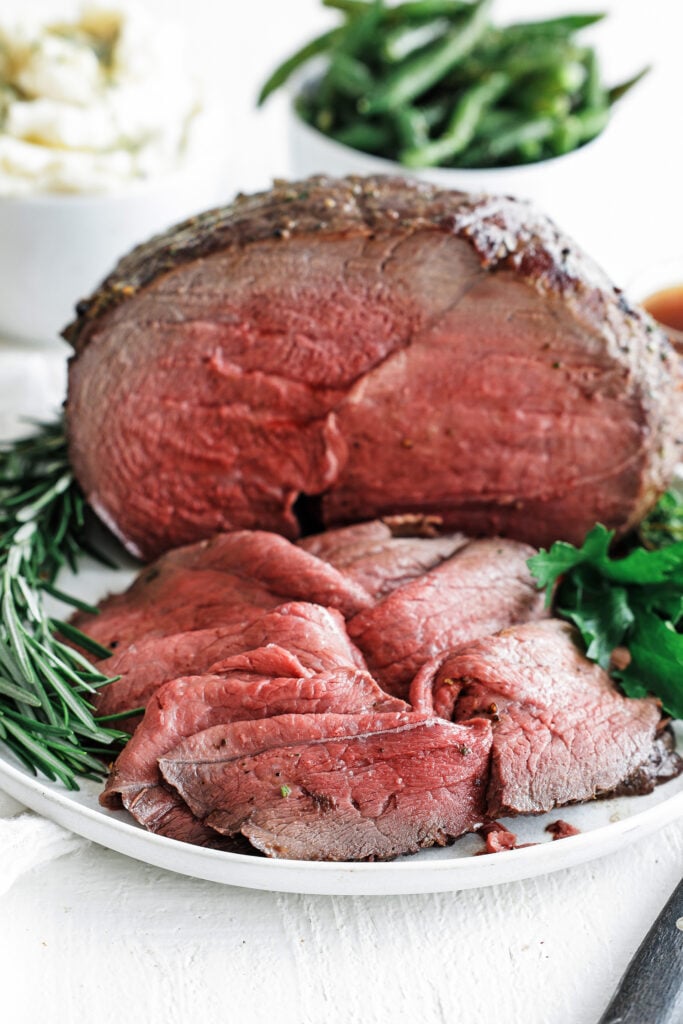

My buddy Keith stopped by right after I took this roast out of the oven, sat down at the counter, and told me it tasted like a $50 steakhouse dinner. I also told my daughter it was filet mignon and she believed me the whole way through the plate. She had no clue that it wasn’t, that’s how tender it is. It is a cut that has no business being this tender, and the whole recipe is how I get there without paying tenderloin money. If you have already gotten comfortable with my reverse sear steak or my bottom round roast, this one is the natural next roast to tackle.
Sirloin Tip Roast (Reverse Seared)
Sirloin tip roast is a low-fat cut of beef from the round primal at the front of the animal’s rear leg, right next to the sirloin. It is also called the knuckle, or the round tip roast, and the name is a bit of a misnomer because it does not actually come from the sirloin section itself. A butcher shop will usually sell you the full sirloin tip, and a grocery store will usually sell you a section of it, which is a piece that is a bit thinner and longer. Both work for this recipe as long as you follow the procedures.
Because this cut has so little fat, tenderness comes down to how you cook it and how you slice it. Get the low and slow reverse sear right and the thin cut across the grain right, and a cheap roast holds its own next to a tenderloin. Rush either one and the same beef goes tough and dry on you. A probe thermometer will keep you on track the whole way. On a roast this low in fat, there is no eyeballing your way to the right doneness.
Below I will walk you through every step so you can get those huge compliments too. I know you can achieve the same results at home. Sound good? Let’s cook!
Ingredients and Substitutions
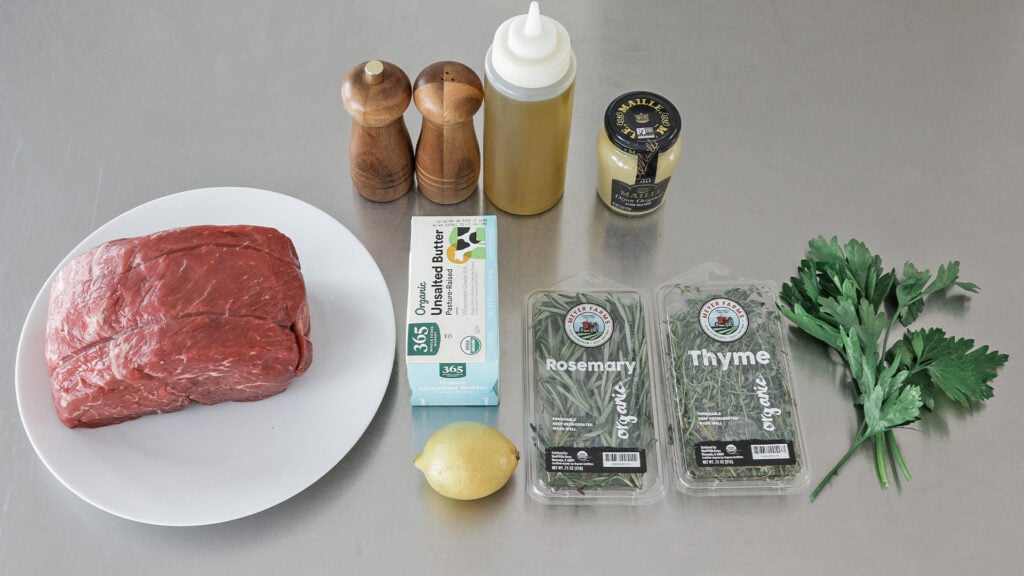
These are the ingredients I use to make this Sirloin Tip Roast Recipe and the Dijon herb butter.
For the roast:
- Sirloin tip roast, trussed, is the star of the plate. Also called the knuckle or round tip roast, cut from the round primal next to the sirloin. Low in fat, beefy, and tender when reverse-seared correctly. Ask the butcher to truss it for you, or truss it yourself. A bottom round or eye of round is a good swap if the tip is not in the case, but adjust the cook time down for a smaller roast.
- Beef tallow, or olive oil – The fat that goes on the outside of the roast before it hits the oven. This adds flavor, helps the salt and pepper stick to the surface, and helps the outside brown as the roast reverse-sears. Tallow adds a beefier flavor; olive oil is the everyday swap.
- Kosher salt – The dry brine that seasons the roast all the way through, pulls moisture into the muscle for juiciness, and dries the surface into a pellicle for a deeper Maillard crust. Diamond Crystal is what I have been using lately.
- Freshly cracked pepper goes on right before the roast hits the oven, over the tallow or oil. Use freshly cracked, never pre-ground. The difference in aroma is real on a plain roast like this.
For the dijon herb butter:
- Unsalted butter, is the base of the compound butter. Whipped light and fluffy in the mixer, it becomes the vehicle for every other flavor and adds the fat this low-fat cut of beef needs to taste rich. Unsalted only, so I control the sodium.
- Fresh thyme – Earthy, minty, softly peppery. Probably my favorite all-around herb on any animal protein and goes amazing with beef.
- Fresh rosemary – Woody, piney, herby. This one has become my new favorite herb with beef. The taste is distinct and takes the meat to another level.
- Fresh parsley – Softly herby and earthy, and the reason the butter has that bright green color.
- Shallots, finely grated – All the onion flavors with none of the sharp raw onion punch. A soft umami partner to beef.
- Garlic, finely grated – The sharp allium note that pairs so well with beef. The more the merrier if you ask me.
- Lemon zest brightens the whole butter and the roast underneath it. A little goes a long way.
- Lemon juice – I was taught in every kitchen I ever worked in to finish a protein with a bright acid, and the juice is exactly that.
- Dijon mustard – Tangy, softly spicy, and in case you have not tried it, mustard and beef are a genuinely amazing combination. Whole-grain dijon works too.
How to Make Sirloin Tip Roast Recipe (Reverse Seared)
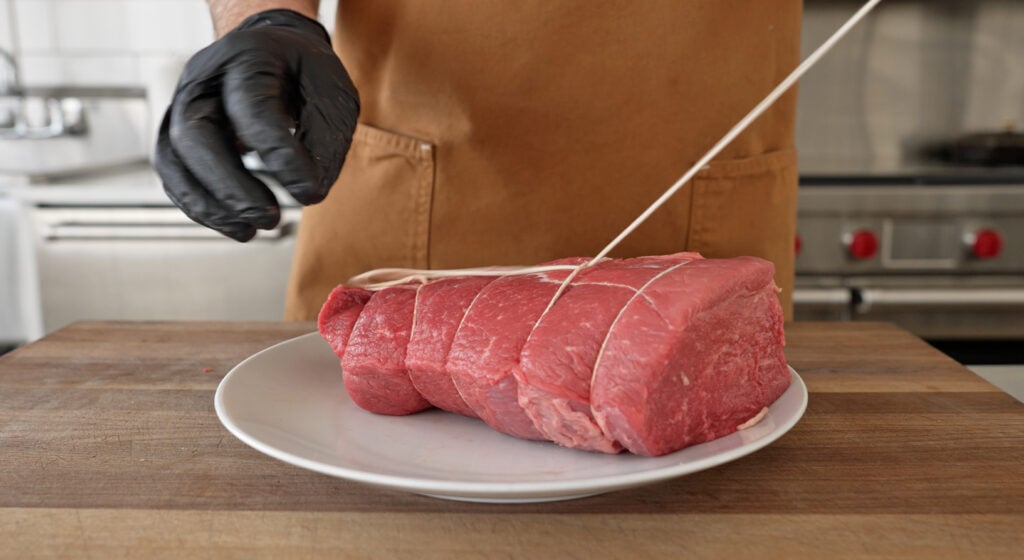
Truss the roast: Ask the butcher to truss the sirloin tip for you when you buy it. If you want to tie it at home, follow my post on how to truss beef. A trussed roast holds its round form as it cooks and the muscle fibers cook at the same rate all the way through instead of the ends drying out ahead of the center.
Dry brine the roast in the fridge: Pat the roast dry on all sides with a paper towel and set it on a rack over a sheet tray. Season it on all sides with kosher salt, about 1 to 1 1/2 teaspoons per pound of beef, and slide the whole tray uncovered into the fridge for at least 4 hours and up to 24 hours. The dry brine does 3 things at once. It pulls moisture into the muscle so the roast stays juicier, seasons the beef all the way through, and dries the surface into a pellicle that will brown into a much deeper Maillard crust when the oven cranks later.
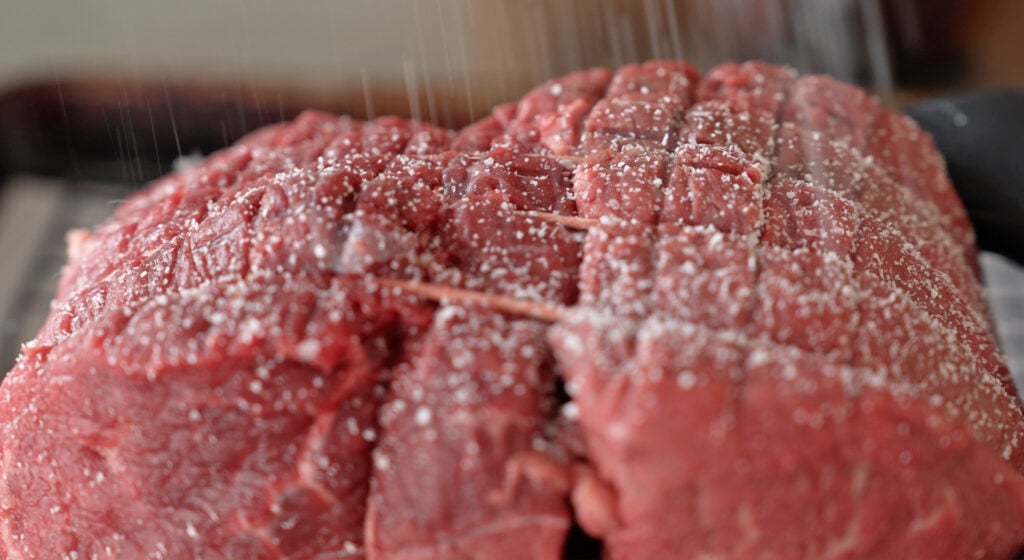
Season and take the chill off: Pull the roast from the fridge, brush the beef tallow or olive oil all over the outside. Season all sides with cracked pepper, about 1/2 teaspoon per pound. Let the roast sit on the counter for a few minutes to take the fridge chill off while the oven preheats to 225°F with no fan.
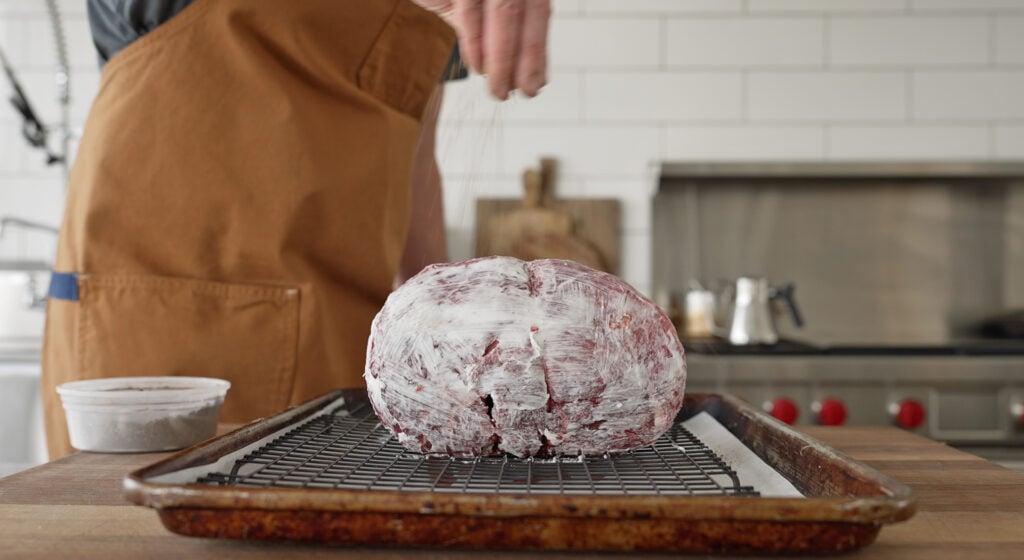
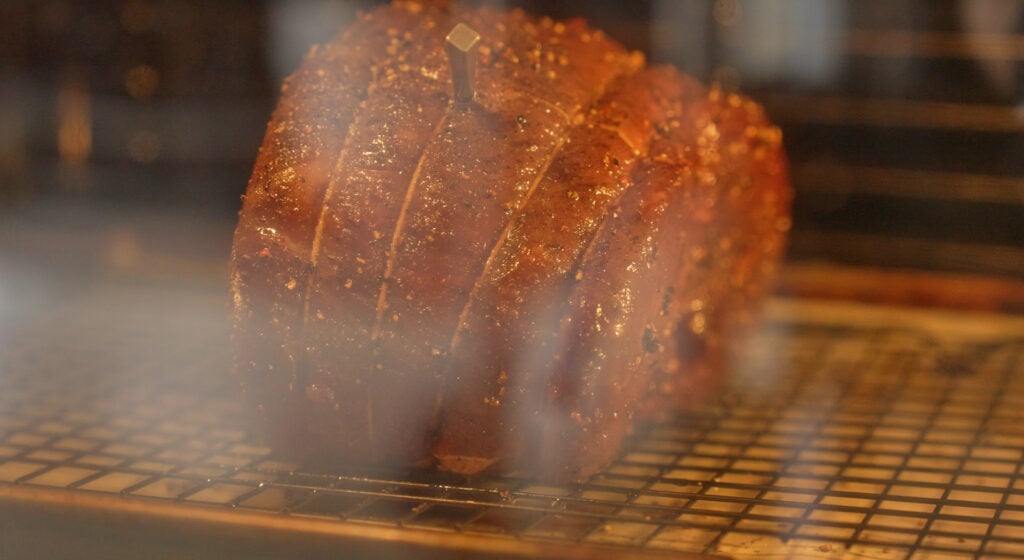
Reverse sear until 98 to 100°F internal: Insert a probe thermometer into the very center of the roast and slide it onto the middle rack of the 225°F oven. Cook until the internal temperature hits 98 to 100°F, about an hour or so depending on the thickness. The low and slow phase is what breaks the muscle fibers down and slowly renders what little fat is on this cut. This is exactly why the finished roast tastes like a much more expensive piece of beef.
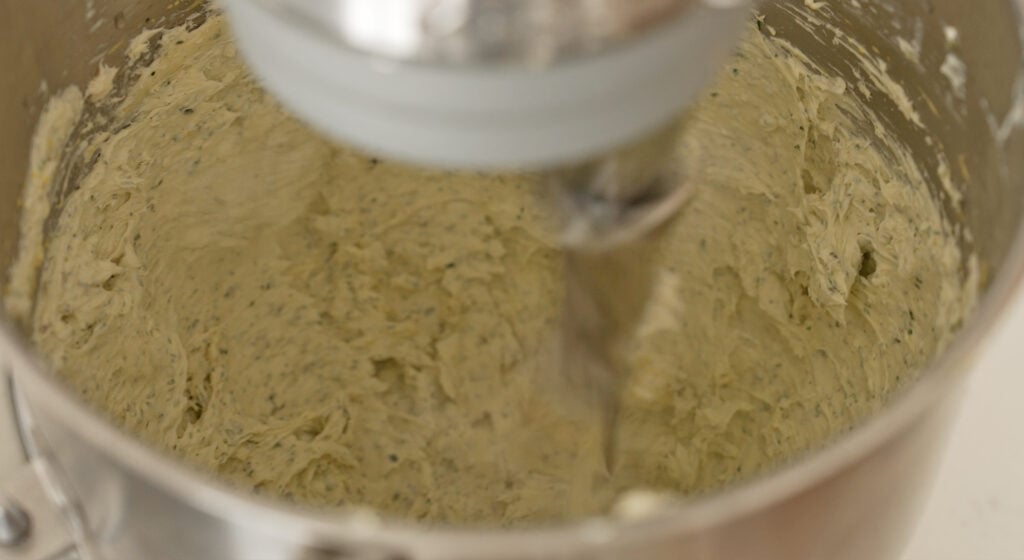
Whip the compound butter while the roast cooks: Add the softened butter to a stand mixer with the paddle attachment. Whip on high for 4 to 5 minutes, until the butter is light, fluffy, and pale. Whipping air into the butter is what gives it that spreadable pillowy texture when it hits the hot roast. Drop the mixer to low and add the thyme, rosemary, parsley, shallots, garlic, lemon zest, lemon juice, dijon, salt, and pepper. Mix until fully combined. Stop and scrape the bowl. Hold at room temperature if you are using it in the next hour, or refrigerate until you need it.
Coat the roast in the Dijon herb butter and crank to 500°F: Once the roast hits 98 to 100°F internal, pull it out and brush a generous ¼ to ⅓ cup of the Dijon herb butter all over the top and sides. Crank the oven to 500°F with the fan on if you have convection. A standard oven set as high as it will go without a fan is fine too.
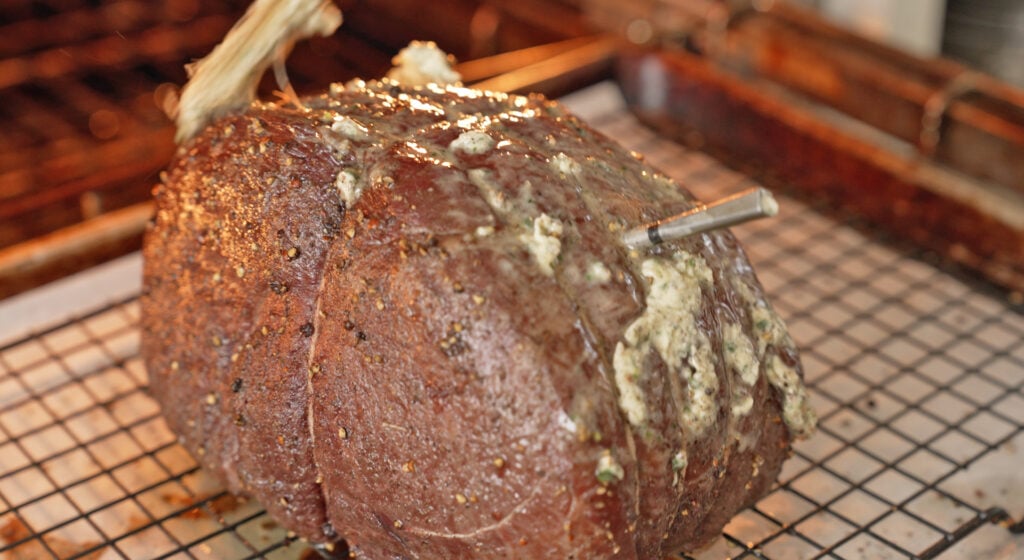
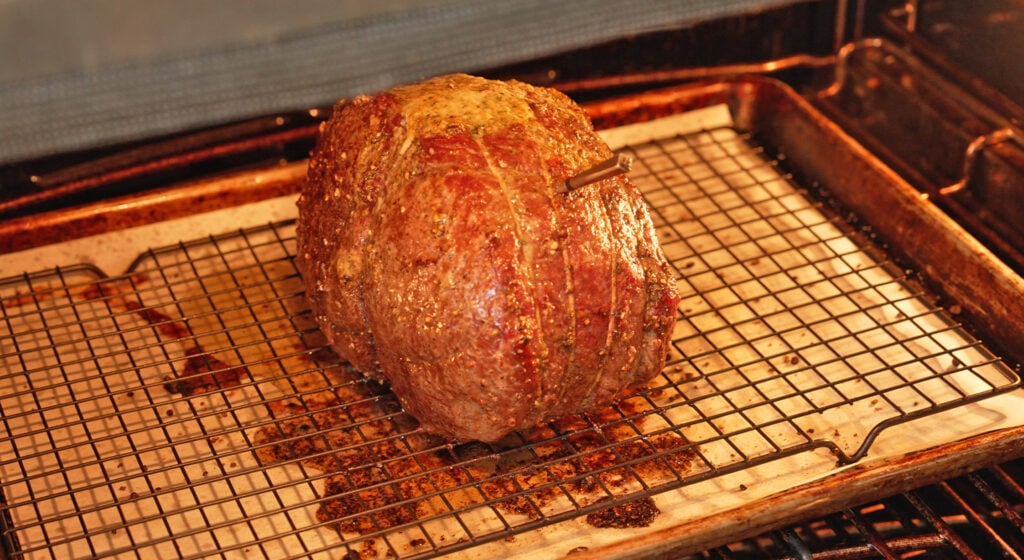
Sear to 110 to 112°F internal: Slide the roast back in and cook at 500°F. The interal temp should hit 110 to 112°F. Pull it out, brush on more of the butter, and rest on a cutting board for 20 to 25 minutes. Do not skip the rest. This is a big piece of meat, and carryover cooking will take the internal temperature from 112 up to about 125°F over those 20 minutes, which is a spot-on medium-rare. Pull it any hotter than 112 out of the oven and you overshoot on the rest.
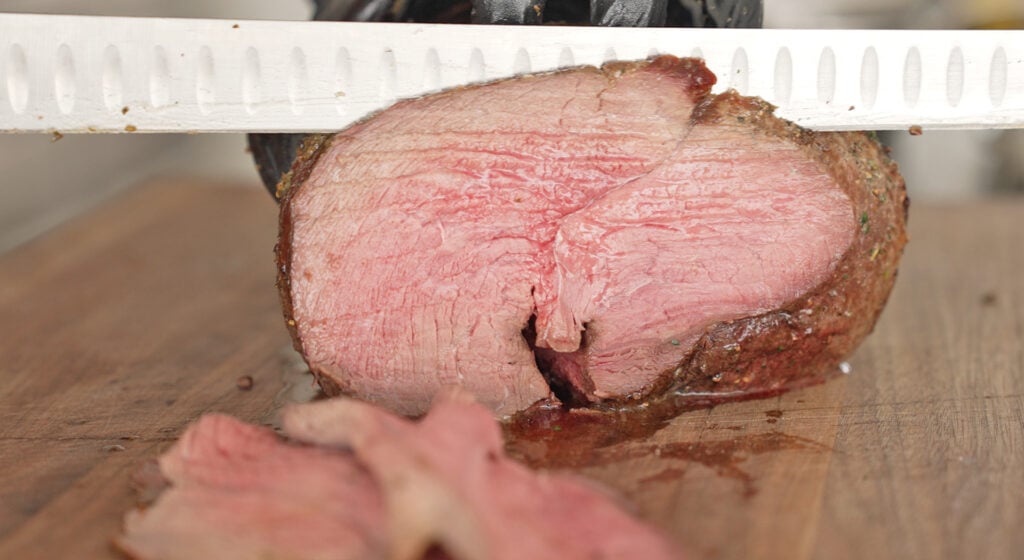
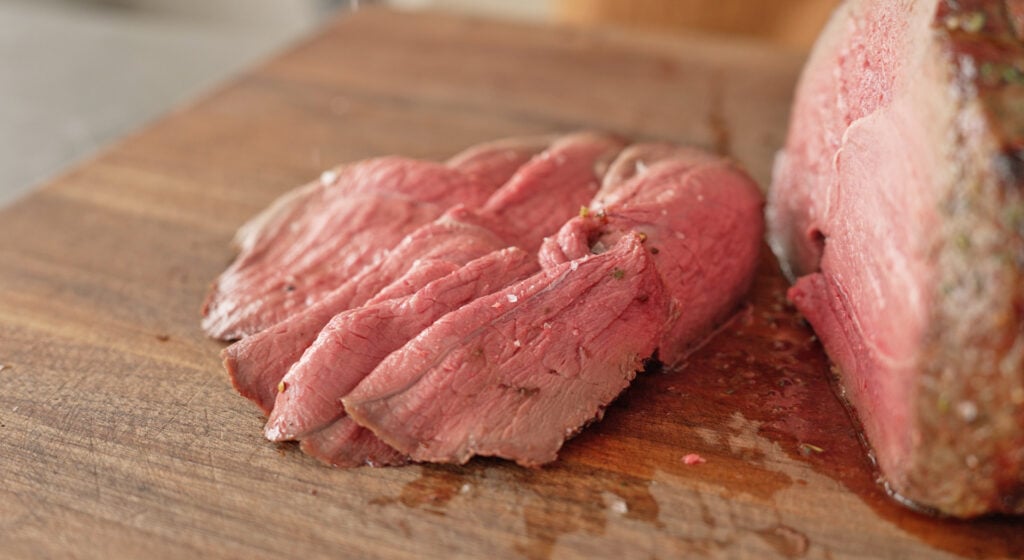
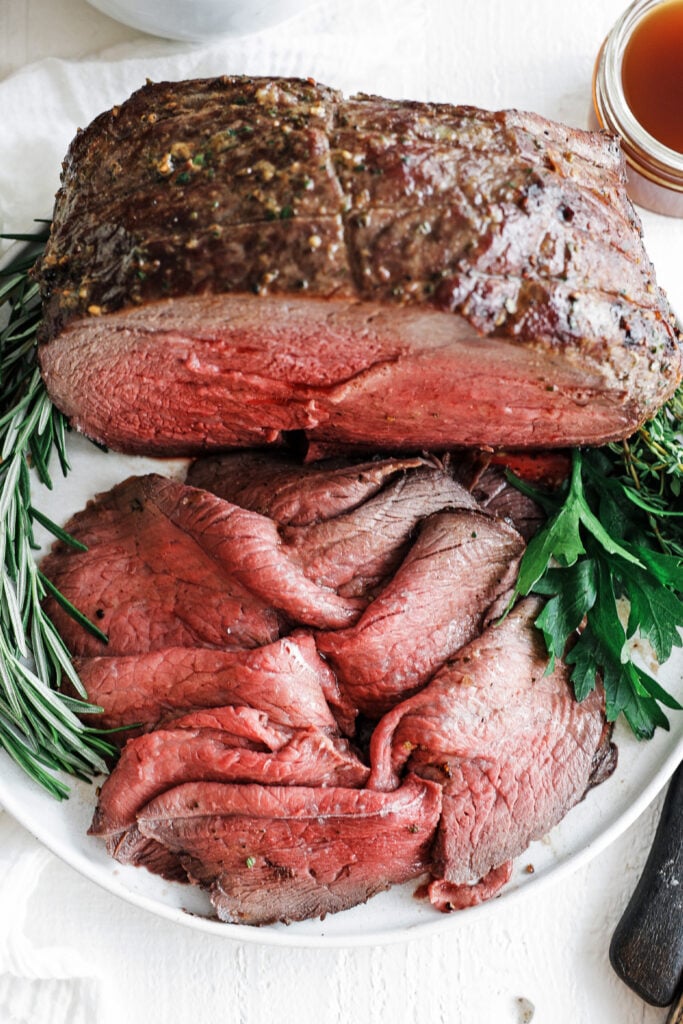
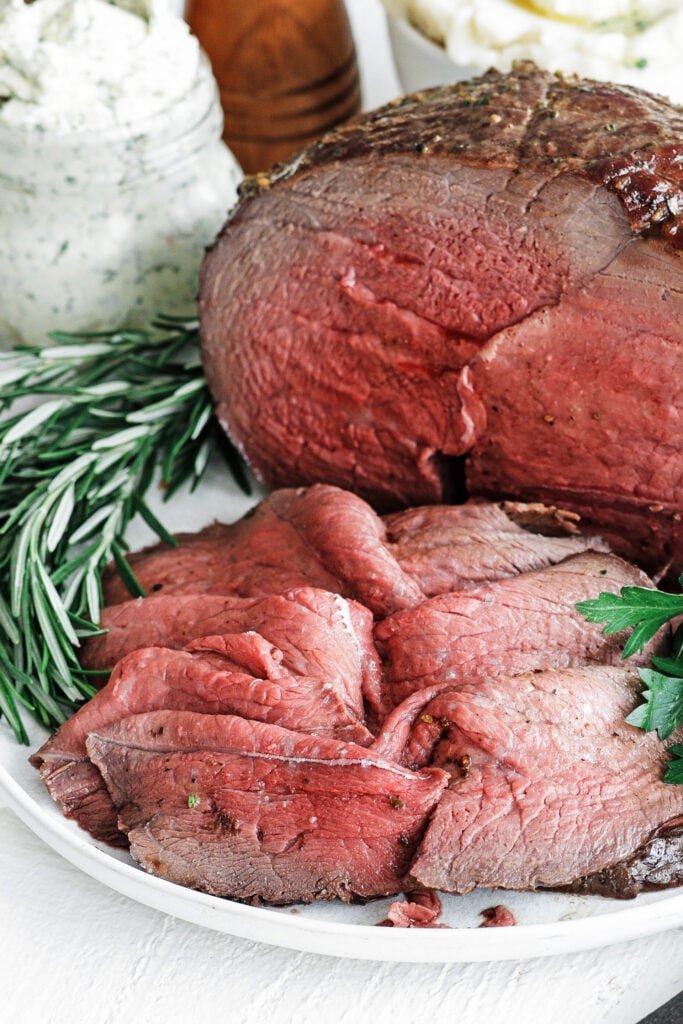
Slice thin, against the grain: Snip and remove the butcher’s twine. Look down at the roast and find the direction the muscle fibers are running left to right. Then, slice straight down across them into paper-thin slices about 1/8 inch thick.
Serve with the extra butter: Plate the roast with a small dish of the Dijon herb butter on the side. If you happen to catch any pan drippings, pour those over the top.
Chef Tip + Notes
First and foremost, use a meat thermometer. On a cut with this little fat, medium-rare is the whole point, and there is no eyeballing your way to 125°F on a roast this size. Time is only a suggestion since the cut will vary in size. Internal temperature is the only rule that matters, and a probe thermometer takes every guess out of the process. Pull the roast at 110 to 112 F, rest 20 to 25 minutes, and the carryover does the last 13 degrees on its own. Pull it any hotter and the resting roast overshoots into medium territory. A cut with this little intramuscular fat starts to dry out and get chewy fast. Trust me, you don’t want that. I recommend the MEATER Pro thermometer. It’s the one I always use, and it’s never failed me.
- Dry brine when you can: The 4 to 24 hour uncovered fridge rest is optional, but the pellicle it forms browns into a much deeper Maillard crust than a same day salt and cook. Plan the dry brine into the day and the roast rewards you for it. I like to dry brine all my bigger roasts, even cuts that are 12 ounces or more. This just allows it to retain so much more moisture for juiciness and it seasons it well.
- Fan on for the 500 F crust if you have it: Convection at 500 F pushes the browning harder and faster than radiant heat alone, and the compound butter forms a crust that looks more roasted than raw-seared. Standard oven at 500 F still works; the fan just accelerates the browning.
- Can I just stop and talk about the butter? My word is this good. Extra dijon herb butter freezes for 6 months, so make the full batch even if you are cooking a smaller roast. Roll the leftover butter into a log in parchment or plastic and freeze it. It goes on anything: a piece of pan-seared salmon, a grilled pork chop, a roasted chicken breast, a bowl of pasta, a plate of roasted vegetables. I actually learned this butter at 16 years old working the line at Legends Country Club in St. Louis, and it was the first time a chef showed me how well mustard and beef go together on a plate.
- Slice against the grain, 1/8 inch thin: This is the finishing technique the tenderness lives or dies on. Look down at the muscle fibers, cut straight across them into thin slices, and rotate the roast when the grain changes direction. I promise if you follow this you won’t believe how a cheap cut could be so good.
Serving Suggestions
What I love the most about this roast recipe is that I can serve with pretty much anything. A bowl of garlic mashed potatoes is a must. A tray of mustard roasted potatoes is great if the mustard theme is already threading through the plate. Then a hot side of garlic green beans is always my wife’s request. A small pitcher of easy homemade gravy is always on the table as well.
For a slightly more upscale Saturday, I place a tray of roasted broccoli, a plate of easy glazed carrots, and the roast down the center of the table. The plate looks like a $50 steakhouse dinner for what a sirloin tip actually costs. Leftover sliced roast is what I usually dice up and drop into my vegetable beef soup the next day. Trying to reheat a medium-rare beef past medium-rare is where a lot of the tenderness starts to walk away.
Make-Ahead and Storage
Make-Ahead: I do not make this one ahead. Reverse-seared sirloin tip is best eaten as soon as it’s done resting. The internal temperature needs to stay right around medium-rare to hold onto the tenderness. The dry brine step is the one piece you can plan ahead. Season the trussed roast, drop it uncovered on the rack in the fridge the day before. Then pick it up when you are ready to cook.
How to Store: Store leftovers covered in the fridge for up to 5 days.
How to Reheat: Slice off the desired amount and lay the slices in a pan. Add a few tablespoons of stock. Warm it at 350°F for 5 to 6 minutes until just heated through. Do not overshoot the reheat.
How to Freeze: I freeze the roast, covered tightly, for up to 3 months. Unfortunately, since this cut is at its best at medium-rare, it’s not great to reheat to temperature. First, thaw the frozen roast overnight in the fridge. Then dice it up, and use it in slow-cooked recipes like Irish beef stew or beef and barley soup.
More Beef Roast and Steak Recipes

Video
Sirloin Tip Roast Recipe (Reverse Seared)
Ingredients
- 4 pounds sirloin tip roast, trussed
- 2-3 tablespoons beef tallow, or olive oil
- 4 sticks softened unsalted butter
- 20 finely minced sprigs of fresh thyme, use the stems if they’re tender
- 4 finely minced sprigs of fresh rosemary, use the stems if they’re tender
- 3 tablespoons finely minced fresh parsley
- 2 tablespoons finely grated shallots
- 3 finely grated garlic clove
- zest of 1 lemon
- juice of 1 lemon, about 2 ½ to 3 tablespoons
- 1 1/2 tablespoons Dijon mustard
- salt and pepper to taste
Instructions
- When purchasing this roast, ask the butcher to truss it for you if it isn’t already.
- Next, pat the roast down on all sides with a paper towel and place on a rack over a sheet tray. Season it on all sides with salt. You will use about 1 to 1 ½ teaspoons per pound as a general rule of thumb. Place it uncovered in the fridge for as little as 4 hours and up to 24 hours.
- When you’re ready to cook it, remove it from the fridge. Brush the beef tallow or olive oil all over the roast and then season it with pepper on all sides. I usually do a 1/2 teaspoons per pound of beef. Let it stand to take the chill off for a minutes and in the meantime, preheat the oven to 225° F no fan.
- Next, place a thermometer into the center of the roast and add the beef to the middle rack of an oven at 225° F and cook until it reaches 98° to 100° internally. This will take about an hour or so.
- While the roast slow cooks, add the softened butter to a stand mixer with the paddle attachment and whip on high speed for 4 to 5 minutes or until it becomes light and fluffy.
- Turn the speed down to low and add in the thyme, rosemary, parsley, shallots, garlic clove, lemon zest, lemon juice, mustard, salt, and pepper and mix to combine. Stop and scrape the bowl if you need to. Keep at room temperature or you can chill it in the refrigerator.
- Once the beef has come too temperature, brush the top of it with about a ¼ to 1/3 cup of the Dijon herb butter all over the top and sides of the roast. Then turn the heat up to 500° F fan on, if you have it. Fan off is totally fine as well.
- Cook the roast until it reaches 110° to 112° F internally. Then, remove it from the oven, brush on bit more of the herb butter and let it rest for 20 to 25 minutes. During this time, the roast internal temperature will go up to 125° F which is a perfect medium rare.
- Remove the butcher’s twine, and very thinly slice against the grain of the roast. I like to use a long meat slicer and cut it about an 1/8 of an inch thick.
- Serve with your favorite sides dishes and Dijon herb butter.
Do you have a cookbook for two or a recommendation?
I do not have a cookbook. Put your cursor over the serving amount and scale it down to serve 2. The problem is you won’t find a sirloin tip small enough to serve only 2.