
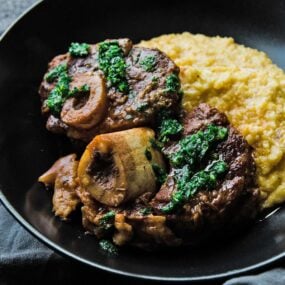
Osso Buco Recipe
This Osso Buco recipe features slow-braised veal shanks simmered with vegetables, tomatoes, wine, and rich stock, creating a fall-off-the-bone tender dish. Being Sicilian, Italian food has always been second nature in my home. I’ve been cooking this osso buco for years, and to this day, it’s still one of my all-time favorites.
Ingredients
For the Osso Bucco:
- 1 cup all-purpose flour
- 4 veal shanks, 8 ounces each
- 2 tablespoons of olive oil
- 1 peeled and large diced yellow onion
- 1 peeled and large diced carrot
- 2 peeled and large diced celery stalks
- 6-8 garlic cloves
- 2 tablespoons tomato paste
- 3 cups roughly chopped fresh tomatoes
- 2 cups dry red wine,, Sangiovese or Barolo
- 4 cups of beef stock
- 2 bay leaves
- 1 bunch of Italian parsley
- 20 to 25 fresh thyme sprigs
- coarse salt and fresh cracked pepper to taste
- 1 gremolata recipe
Instructions
- Preheat the oven to 325°.
- Add the flour to a bowl or a plate and season it very well with salt and pepper, about 1 tablespoon of salt and 1/2 teaspoon of pepper.
- Dredge the veal shanks on all sides in the flour and set them aside.
- Next, heat the olive oil in a Dutch oven over medium-high heat and heat until it begins to smoke lightly.
- Add the veal shanks, turn the heat down to medium, and sear them until they are golden brown on all sides, about 4 to 6 minutes per side.
- Remove the veal shanks and add the onions, carrots, celery, and garlic to the pot and sauté for 3 to 4 minutes or until lightly browned.
- Mix in the tomato paste and cook for two minutes.
- Add the tomatoes and deglaze with the wine. Cook for 2 minutes.
- Place in the beef stock, bay leaves, parsley, thyme, salt, and pepper. Be sure to try the liquid to make sure it's well seasoned.
- Add the veal shanks back into the pot, submerge them, place a cover over the pot, and cook in the oven for 2 to 2 ½ hours in the oven at 325°. or until they are very tender and easily remove from the bone.
- Serve the Osso Buco and some of the sauce over top, and add the gremolata to the top of the veal shanks. We used to serve all the vegetables in the braising liquid underneath the osso buco at a restaurant I worked at.
Notes
The most important thing I do to make the best Osso Buco is properly searing the veal shanks before braising. Take the time to get that deep, golden-brown crust because it lays the foundation for a fantastic sauce. Skipping this step? Not an option, it makes all the difference.
Take it slow: Never rush the braise, 2 to 2 ½ hours of low, slow cooking makes the meat fall-apart tender and full of flavor. This is key!
Layer the seasoning: When you season at every step, from the flour dredge to the braising liquid, everything becomes better seasoned. In addition, you'll end up using less salt as the flavor concentrates.
Choose the right wine: Use a good Sangiovese or Barolo since the wine reduces and intensifies in the sauce. The rule of thumb I was taught is to cook with what you would also drink.
Don’t skip the gremolata: The fresh parsley, garlic, and lemon zest cut through the richness and bring everything to life. It seems like a random garnish, but I promise it brightens the entire dish up.
Dried herb swaps: If I’m out of fresh parsley or thyme for the braise, I use 3 tablespoons of dried parsley or 1 ½ tablespoons of dried thyme instead.
Use tomato paste wisely: Cooking the tomato paste for a couple of minutes helps darken and thicken the braising liquid. This process is known as pince.
Save the extra liquid: Any leftover braising liquid? Strain and freeze it. This is one of the best parts, and it essentially turns into an incredible homemade beef stock for another meal.
Make-Ahead: You can make this up to 1 hour ahead of time. Keep it warm, covered over low heat.
How to Store: Cover and refrigerate it for up to 4 days. Cover and keep in the freezer for up to 2 months. Thaw for one whole day before reheating.
How to Reheat: Add your desired portion of ossobuco and braising liquid to a small pot and cook over low heat until hot, stirring occasionally.
Nutrition
Calories: 435kcalCarbohydrates: 43gProtein: 27gFat: 8gSaturated Fat: 2gCholesterol: 64mgSodium: 637mgPotassium: 1391mgFiber: 4gSugar: 8gVitamin A: 4028IUVitamin C: 32mgCalcium: 107mgIron: 5mg