
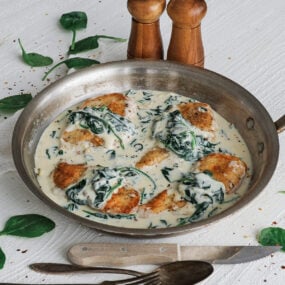
Chicken Florentine Recipe
Chicken Florentine features juicy pan-seared chicken and spinach in a creamy Mornay sauce for a simple and elegant French Italian meal.
Ingredients
For the Sauce:
- 1/2 peeled shallot
- 1 bay leaf
- 1 clove
- 4 cups whole milk
- 5 tablespoons unsalted butter
- 4 tablespoons all-purpose flour
- pinch of nutmeg
- 4 ounces shredded gruyere cheese
- 2 ounces finely grated Parmigiano Reggiano
- Salt and ground white pepper to taste
For the Chicken:
- 2 12-14 ounce chicken breasts
- ½ cup all-purpose flour
- 1/3 cup finely grated Parmigiano Reggiano
- 2 teaspoons Italian seasoning, optional
- 4 tablespoons olive oil
- 1 peeled small-diced shallot
- 2 finely minced garlic cloves
- 8 ounces baby spinach
- 1/3 cup dry white wine
- salt and pepper to taste
Instructions
For the Sauce:
- Make a 1” incision into the top of the half shallot and press in the bay leaf so that it is secure. Press the clove into the shallot right next to the bay leaf. This makes it easy to remove in the end.
- In a medium-sized pot, add the milk along with the shallot-bay leaf combination and scald it over low to medium heat.
- In the meantime, in a separate small pan over low heat, add 3 tablespoons of butter and heat until it’s melted. Whisk in the flour until combined to make a roux.
- Once the milk is scalded, whisk in the roux and bring the heat to high just until boiling. Then turn it down to low-medium and cook until thickened.
- Finish it with nutmeg, salt, and pepper. Strain it through a fine mesh strainer and return it to a medium-sized pan.
- Finish the sauce by whisking in the gruyere, Parmigiano, and the remaining 2 tablespoons of butter. Set it to the side.
For the Chicken:
- Slice the chicken in half width-wise and set it aside.
- In a shallow bowl, whisk together the flour, Parmigiano, optional Italian seasoning, salt, and pepper.
- Thoroughly coat each chicken breast in the flour mixture, then set it aside on a plate.
- Add the olive to a large frying pan over medium heat and heat for 90 seconds.
- Place the chicken breasts in the pan and cook for 3 to 4 minutes per side or until browned on each side and just cooked through. Set the breasts to the side on a plate.
- In the pan, add in the shallots and garlic and saute for 1 minute over low to medium heat.
- Add the spinach and stir continuously until about half of it is wilted.
- Deglaze with the white wine and cook until only 2 or so tablespoons of liquid remain.
- Add in the Mornay sauce. Season with salt and pepper.
- Place the chicken in the sauce and serve.
Notes
Make a mental note to taste every element of this dish—particularly the Mornay sauce—as you go. I taste it before adding the cheese, after adding the cheese, and once more after combining it with the spinach. I always keep tasting spoons within reach for this reason.
Nappe consistency: I know the béchamel is perfectly thickened when it completely coats the back of a spoon. This is known as “nappe.”
Don’t break the Mornay: When making the Mornay, I keep the heat on low and whisk constantly to keep the sauce silky and lump-free. If I turn the heat up too high, the proteins in the cheese will clump and "break" the emulsion.
Golden seared chicken: I have a few tricks up my sleeve when it comes to perfectly seared chicken. First, I pat the chicken breasts completely dry, and then I preheat the oil until it’s shimmering and lightly smoking. After I lay the chicken in the pan, I don’t touch it. This is when the Maillard reaction does its thing, developing that gorgeous golden crust.
Add-in ideas: Add sliced mushrooms, sun-dried tomatoes, artichoke hearts, capers, or roasted red peppers with the aromatics (after cooking the chicken). Or, top the chicken with crispy bacon, prosciutto, or pine nuts at the end.
Make-Ahead: You can prepare the Mornay sauce up to 2 days ahead and keep it covered in the refrigerator until you’re ready to use it. The chicken and spinach are always best served fresh.
How to Store: Cover the chicken and sauce, and store them in the fridge for up to 3 days. I don't recommend freezing, as the sauce tends to break and become grainy after thawing.
How to Reheat: Place the chicken and sauce in a small skillet over medium-low heat, then add a splash of milk or broth. Cover and stir occasionally until it’s warmed through.
Nutrition
Calories: 840kcalCarbohydrates: 35gProtein: 50gFat: 54gSaturated Fat: 25gPolyunsaturated Fat: 3gMonounsaturated Fat: 21gTrans Fat: 1gCholesterol: 177mgSodium: 821mgPotassium: 1187mgFiber: 3gSugar: 13gVitamin A: 6643IUVitamin C: 18mgCalcium: 946mgIron: 4mg